Open Tables
An ordinary evening, to which anyone may come
The Open Table is the one gathering that is not held behind a door. It is not an introduction to anything and it is not the first step of anything. Attendance is free, no contribution is requested at any point, and no reservation is needed. Nothing follows from coming, and nothing follows from not coming again.
The order of the evening
- 18:00Arrival. The table is already laid.
- 18:10Silence, twelve minutes. You may leave the room; no one will follow.
- 18:22A reading of not more than four hundred words. The author is given afterwards.
- 18:30Discussion. One question, put plainly. You need not speak.
- 19:15The meal, served by those who did not cook.
- 20:00Practical business: repairs, deliveries, the rota.
- 20:25Notices. Nobody present is introduced, named, or pointed out.
- 20:30Close. The empty place is cleared last.
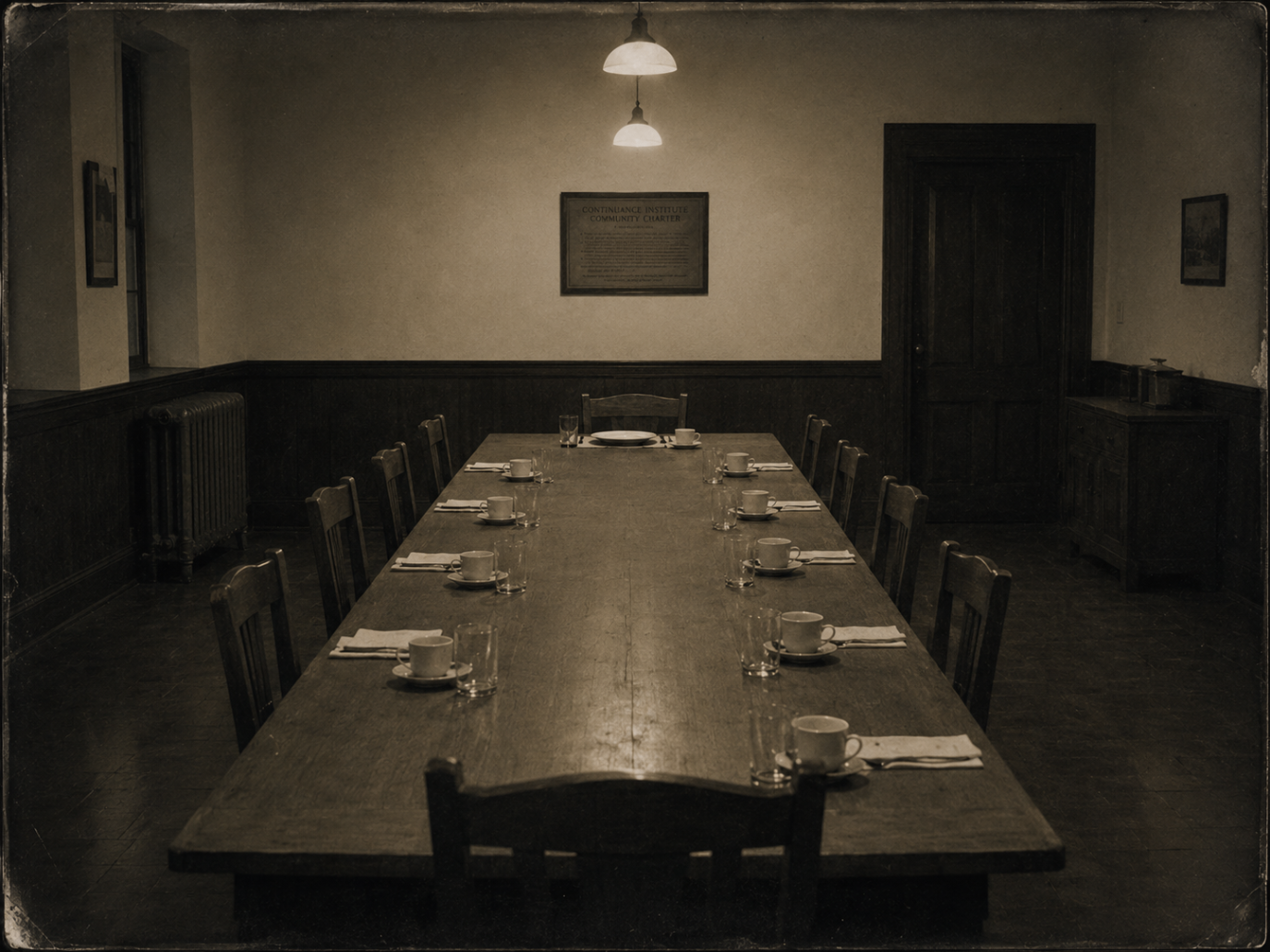
The room is laid before anyone arrives: plain white cups, a jug, the bread board at the end of the table, and the week's rota pinned by the kitchen door. Water is already heating. The twelve minutes begin when the room is quiet and not when the clock says so, and a brass bell — where a house has one — marks the end of them.
The reading is taken from the House Reader, the anthology kept at the houses since 1977. The house may leave a reading out and read something of its own instead; where it does, the choice is written in the book in one line and no reason is asked for. The author and the source are given after the reading, so that the words are heard before the name.
Before you come
- Wear what you would wear to a neighbour's kitchen.
- You will not be asked what you believe, or what you do for work.
- You need not give your name, and you will not be asked for it.
- You will be asked to carry something, or hand something to someone.
- You may leave at any point in the evening without explanation.
- Bring nothing. If you bring something, it will be eaten.
Where and when
There is no common evening. Each house settles its own, and two houses hold no Open Table at all: one is not resourced for it, and one opens instead in another form.
- North HousePenobscot County, Maine
The house keeps the Open Table among its recurring forms.
- Shore HouseLunenburg, Nova Scotia
A seasonal shared meal and lecture is kept, spring and autumn.
- Fell HouseScottish Borders
The house keeps the Open Table, at longer intervals than most.
- Karst HouseUpper Carniola
The house keeps the Open Table, and a lecture in the reading period.
- Cedar HouseAomori Prefecture
The house keeps no table of its own; residents cook at the community meal in the town.
- River HouseRamsey County, Minnesota
The house keeps the Open Table, and a meal is provided at it.
- Orchard HouseYamhill County, Oregon
The house keeps the Open Table, and a pressing day in the autumn.
- Lantern HouseSocorro County, New Mexico
The house keeps the Open Table twice in the year, and no more.
- Briar HouseAlbemarle County, Virginia
The house keeps the Open Table among its recurring forms.
Notice of intended attendance
No reservation is required and none is refused. A notice is a courtesy to the kitchen: it tells the house how many places to lay. How the year is ordered, and where the Open Table falls in it, is set out in the House Calendar.
An account of the two routes by which an enquiry is received, and of what is done with one once it is entered, is set out on the correspondence page. A house will not write first.
What is written down
The number of people present, so that the kitchen knows what to cook next month. That is the whole of the entry. No name is written in any book unless the person asks, in that evening, for it to be written, and a name given at the door for the sake of the meal is not a name given for the book.
Nobody is telephoned, written to, or asked after because they came, and nobody is telephoned, written to, or asked after because they did not come again. A house that follows up an attendance has made an error, and the error is corrected by the steward and not by the visitor.
From the archive
The rota, as posted in 1981.
The order of the evening is a duplicated kitchen notice that has never been withdrawn.
Carbon copy · house file · not to leave the archive room
TO ALL HOUSES. FOR PINNING IN THE KITCHEN.
1. Those who cook do not serve. Those who serve do not clear. Those who clear do not speak at the business.
2. The twelve minutes begin when the room is quiet and not when the clock says so. If the room is not quiet by ten past, the reading is brought forward and the silence is kept at the end instead.
3. No one present is welcomed by name, introduced, or pointed out at the notices. No one is asked what they do.
4. One place is laid and left empty. It is cleared last.
5. Nothing is collected. If money is left on the table it is entered in the ledger of the house and the person is written to.
This notice replaces the notice of March 1979 and is to be read aloud once a year.
PRO/1981/02 · Shore House
Most gatherings do not take place at a House. Thirty-eight local circles keep the same order of the evening in halls, back rooms and libraries, under the standing orders of 1991.