Institutional history
A practice carried forward
The Continuance began as a series of private Thursday gatherings concerned with attention, responsibility, and the growing fragmentation of ordinary life. In 1974, those gatherings became a permanent institution.
The Institute is member-supported, holds eleven residential houses and thirty-eight local circles, teaches no doctrine, and has never been led by one person. Its work is unremarkable when described plainly: shared meals, structured observances, service in the places where its houses stand, and the maintenance of a single continuous archive.
What follows is the public account of how that came about. It is assembled from the Common Record and is incomplete where the Record is incomplete. Where two documents disagree, the Institute keeps both and marks the matter referred.
- Publicly established
- 1974
- Informal origins
- Private Thursday gatherings, 1968–1973
- First permanent location
- North House, Penobscot County, Maine
- Residential houses
- 11
- Active local circles
- 38
- Central archive
- The Common Record
Chronology
Entered oldest first, as the house books are read.
Several records predating the Thursday gatherings contain practices or phrases later associated with the Continuance. The Institute does not treat these records as evidence of an earlier founding.
1968–1973
The Thursday gatherings
Eleanor Vale and Thomas Orrell convene a small gathering on Thursday evenings, first in Bangor and afterwards at a farmhouse outside Orono. Attendance is by invitation and rarely exceeds fourteen. No record is kept beyond a list of who ate.
Sources (2)
- [1]
HB/North
House books, North House
House book · 1974 onward · North House
The list of who ate, kept in the house books.
Read aloud in pairs at the annual reconciliation. Not published in facsimile.
Standing: HeldEntered without a reference in the textReturn to the passage
- [2]
PHO/1971/22
Photograph: kitchen, North House
Photograph · Catalogued as 1971 · North House
A kitchen photograph catalogued three years before the founding.
The catalogued date precedes the founding by three years. The catalogue has not been amended.
Standing: HeldEntered without a reference in the textReturn to the passage
North House papers
1974
The Founding Letter
Vale writes to the twenty-two people then attending, setting out her reluctance to formalise the gatherings and her reasons for doing so nonetheless. The letter is read aloud, adopted at the following Thursday, and has not been amended.
Sources (2)
- [1]
CR-F-0001
The Founding Letter
Published record · 1974 · North House
The letter as adopted, unamended.
Read aloud at a first attendance. Not amended since adoption.
Standing: HeldEntered without a reference in the textReturn to the passage
- [2]
COR/1976/014
Letter, E. Vale to T. Orrell
Correspondence · 9 November 1976 · North House
Vale to Orrell, two years afterwards, on the same purpose.
Reconciled with the Common Record, revision 12.0.
Standing: HeldEntered without a reference in the textReturn to the passage
North House papers
1974
North House established
A disused grange hall and two outbuildings in Penobscot County, Maine, are taken on a long lease and become the first permanent location. The word 'continuance' appears for the first time in a note about the building's insurance.
Sources (2)
- [1]
HB/North
House books, North House
House book · 1974 onward · North House
The lease and the insurance note in which the word first appears.
Read aloud in pairs at the annual reconciliation. Not published in facsimile.
Standing: HeldEntered without a reference in the textReturn to the passage
- [2]
WEB/1998/1 · houses.html
The Continuance Institute - The Houses
Archived web page · 11 May 1998 · The public site, 1998
The houses as listed on the Institute's own site in 1998.
Printout held at the North House, dated 2 June 1998. Transcribed 2004.
Standing: TranscribedEntered without a reference in the textReturn to the passage
North House · House books, North House
1976
The first Weekly Observance
The observance is fixed in the form still kept: silence, reading, discussion, a shared meal, and an hour of practical work. Vale writes to Orrell that a practice survives only when it can be carried by ordinary people on difficult days.
Sources (2)
- [1]
COR/1976/014
Letter, E. Vale to T. Orrell
Correspondence · 9 November 1976 · North House
The letter containing the sentence quoted.
Reconciled with the Common Record, revision 12.0.
Standing: HeldEntered without a reference in the textReturn to the passage
- [2]
PRO/1996/11
House Handbook: Order of a Weekly Observance
Procedure · 1996 · Stewardship
The order of the observance as later printed.
Standing: HeldEntered without a reference in the textReturn to the passage
North House · Minute book, North House
1977
The first Members' Handbook
The house vocabulary is printed for the first time: house, circle, Open Table, observance, fellowship, steward. Two editions have followed. The Institute prints all three definitions together rather than replacing the earlier wording.
Sources (1)
- [1]
HAN/1977/1
Members' Handbook — the house vocabulary, three editions
Handbook · 1977, 1994, 2011 · Stewardship
All three editions of the vocabulary, printed together.
All three wordings are printed together. The earlier wordings are not withdrawn.
Standing: HeldEntered without a reference in the textReturn to the passage
Members' Handbook, first edition
1979
Incorporation, and the second house
The Institute is incorporated as an educational and service organisation. Shore House is founded at Lunenburg, Nova Scotia. The phrase 'the absent chair' is first recorded this year, in the minutes of an Open Table held at the North House in November.
Sources (2)
- [1]
MIN/1979/11
Open Table minutes, November 1979 — the absent chair
Minutes · November 1979 · North House
The footnote in which 'the absent chair' is first recorded.
The phrase is recorded in a footnote. The footnote does not explain it, and no earlier use has been found.
Standing: Held in partEntered without a reference in the textReturn to the passage
- [2]
ANN/1979–
Reports of the Stewardship
Annual report · Annual, 1979 onward · The Continuance Institute
The first report of the stewardship, for the year 1979.
The series is unbroken as printed. Four years are listed without a document behind them.
Standing: Held in partEntered without a reference in the textReturn to the passage
Shore House · Open Table minutes, November 1979
1982–1986
Archival consolidation and organisational transition
A period of archival consolidation and organisational transition. Publication of the Journal is suspended and later resumed.
Sources (2)
- [1]
MIN/1985/03
Stewardship Meeting — Minutes
Minutes · 14 March 1985 · Shore House
A stewardship meeting held within the period. Portions withheld.
Portions withheld under closed observance. The withheld portions are not summarised.
Standing: Held in partAccess: Partially closed. Redactions applied 1986; reviewed 2019; retained.Entered without a reference in the textReturn to the passage
- [2]
ANN/1979–
Reports of the Stewardship
Annual report · Annual, 1979 onward · The Continuance Institute
Reports are listed for these years. Four of the documents are not held.
The series is unbroken as printed. Four years are listed without a document behind them.
Standing: Held in partEntered without a reference in the textReturn to the passage
abridged
1987
The Common Record reconstituted
The archive is re-catalogued at the North House under a single continuous numbering, and annual reconciliation against the house books begins. The Journal resumes with an issue of collected field notes.

Reconciliation at the North House. The ledgers are read aloud in pairs. Sources (2)
- [1]
MIN/1987/RC
Reconciliation minute, 1987
Minutes · 1987 · North House
The minute directing the re-cataloguing.
The minute records the re-cataloguing. It does not record what was catalogued before it.
Standing: HeldEntered without a reference in the textReturn to the passage
- [2]
REP/1989/AR
Annual Report, Year Ended 31 December 1989
Report · April 1990 · The Continuance Institute
The first full report published under the continuous numbering.
This document has been reconciled with the Common Record.
Standing: HeldEntered without a reference in the textReturn to the passage
North House · Reconciliation minute, 1987
1991
The circles are recognised
Nonresidential local gatherings, until then informal, are given standing and a steward apiece. Thirty-eight are currently active. A circle is not a smaller house; it is a different obligation.
Sources (1)
- [1]
PRO/standing
Standing procedures of the houses
Procedure · As presently in force · Stewardship
Standing orders as presently in force.
Standing: HeldEntered without a reference in the textReturn to the passage
Standing orders, 1991
1998
The death of Eleanor Vale
Eleanor Vale dies at sixty-three. One residential property is lost in the October fire. The stewardship elects not to rebuild. She had asked that no memorial observance be held and that the ordinary Thursday continue that week. It did.
Sources (2)
- [1]
HB/North
House books, North House
House book · 1974 onward · North House
The minute book entry for that week's Thursday.
Read aloud in pairs at the annual reconciliation. Not published in facsimile.
Standing: HeldEntered without a reference in the textReturn to the passage
- [2]
WEB/1998/1 · index.html
The Continuance Institute - Home Page
Archived web page · 2 June 1998 · The public site, 1998
The site as it stood in June 1998, carrying no notice of her death.
Printout held at the North House, dated 2 June 1998. Transcribed 2004.
Standing: TranscribedEntered without a reference in the textReturn to the passage
Minute book, North House
2006
Public transcriptions revised
The Institute re-transcribes its founding documents for public reading, correcting spelling and expanding contractions without altering wording. The originals remain the authority in every case of doubt.
Sources (1)
- [1]
OH/2004/07
Oral history: Dorothy Hargreaves
Oral history · Recorded 12 June 2004 · North House
Recorded two years before, in the same programme of transcription.
Standing: TranscribedAccess: Open. Consent on file.Entered without a reference in the textReturn to the passage
Reconciliation minute, 2006
2019
South House, and the review of the network
South House completes the present operating network: ten houses maintaining residential or public programmes. The circles are reviewed in the same year and three arrangements are dissolved without any change to the standing of their members. The stewardship has since declined three further offers of property on the grounds that the Institute can only keep what it can keep well.
Sources (2)
- [1]
ANN/1979–
Reports of the Stewardship
Annual report · Annual, 1979 onward · The Continuance Institute
Property offers received and declined, reported annually.
The series is unbroken as printed. Four years are listed without a document behind them.
Standing: Held in partEntered without a reference in the textReturn to the passage
- [2]
WEB/1998/1 · houses.html
The Continuance Institute - The Houses
Archived web page · 11 May 1998 · The public site, 1998
The 1998 list, which counts the houses differently.
Printout held at the North House, dated 2 June 1998. Transcribed 2004.
Standing: TranscribedEntered without a reference in the textReturn to the passage
The founders
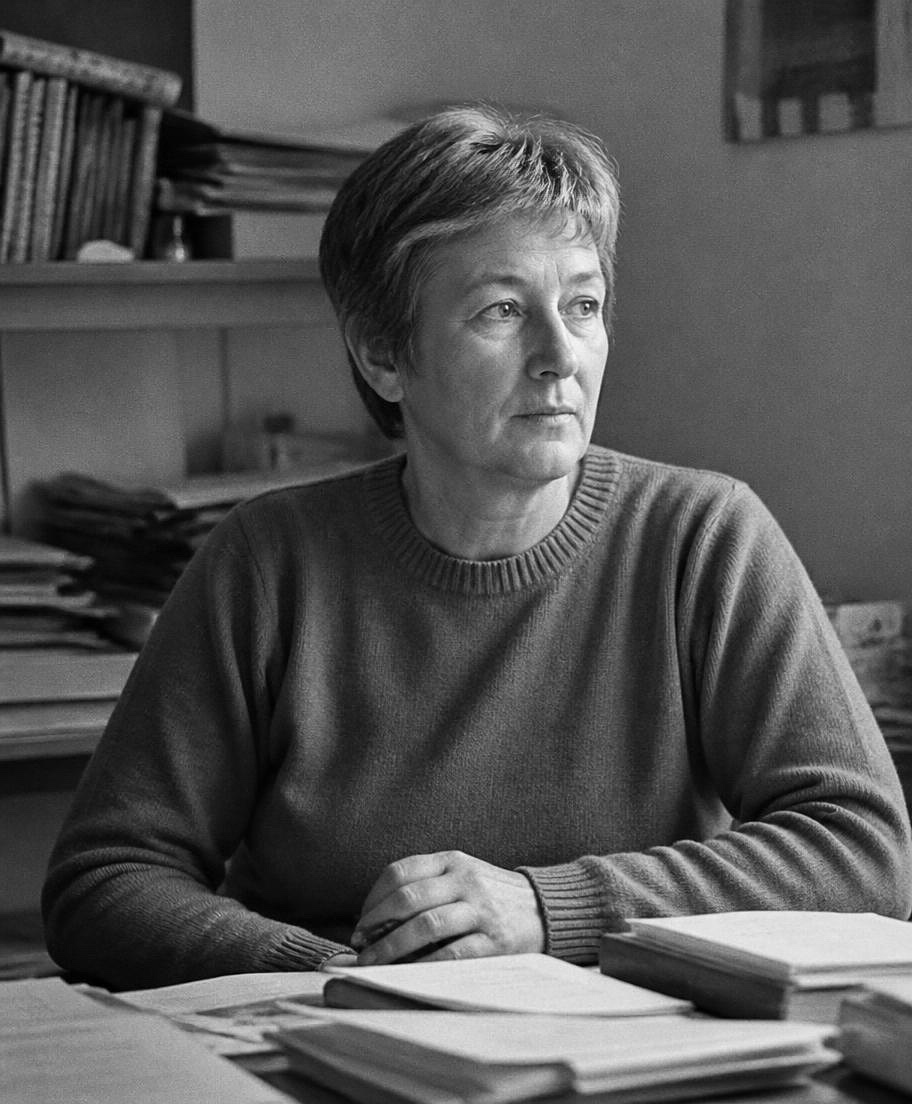
Dr. Eleanor Vale, 1935–1998
Eleanor Vale was born in 1935 in Bangor, Maine, and trained as a historian of institutions — hospitals, mutual societies, county archives, the sort of bodies that keep minutes for a century and are then dissolved in an afternoon. She worked for eighteen years as a university archivist, and her scholarly reputation, such as it was, rested on a single argument made repeatedly in unfashionable places: that the papers an institution keeps about its own conduct are a better guide to its character than anything it publishes.
Vale distrusted institutional authority, including her own, and said so in writing often enough that the phrase 'necessary danger' has passed into house use. Her objection was not to rules but to deference: she held that a body which cannot be corrected by the people inside it has already stopped being what it claims to be, whatever its rules say. Several of the Institute's least convenient arrangements — the refusal of any single leader, the requirement that disagreeing records both be kept, the standing rule that no practice may be defended by reference to a founder's wishes — exist because she insisted on them against the preference of the room.
Thomas Orrell, born 1938
Thomas Orrell was born in 1938 and co-organised the Thursday gatherings with Eleanor Vale from 1968. Where Vale was concerned with what should be written down, Orrell was concerned with what should be done, and the practical shape of the Institute is largely his: the residential period, the sharing of cooking and repair, the requirement that every house undertake service in the place where it stands.
Orrell withdrew from public leadership in 1983. The Institute’s public record contains no complete account of his later life.
The three principles
Set out in the Founding Letter and unamended since. They are intended to be usable rather than admired, and nobody is asked to affirm them.
- Attention
- To perceive without immediately consuming, judging, or reacting.Attention is not concentration. Concentration narrows; attention receives. The practice begins here because nothing else can be built on a mind that arrives late to its own experience.
- Continuity
- To act as though today belongs to the same life as tomorrow.Most harm is done by people who have quietly decided that this week does not count. Continuity is the refusal of that exemption, held daily, in small matters, without ceremony.
- Obligation
- To accept that a meaningful life is formed through responsibility to others.We do not treat obligation as a burden placed on freedom. We treat it as the material from which a life is actually made. What you are obliged to, you will eventually resemble.
The mark
Three forms, and the earlier printing
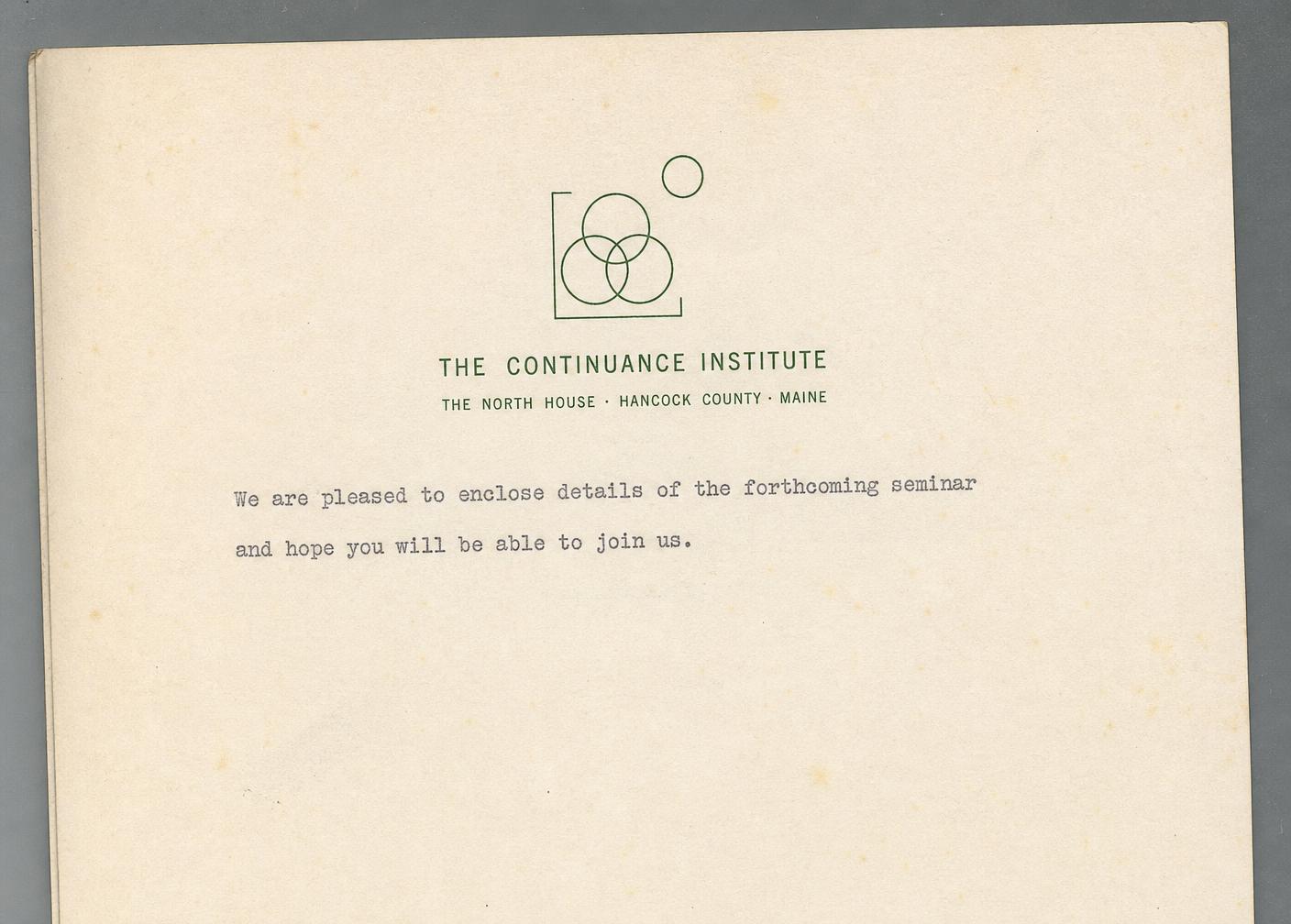
The mark in present use is three offset circles within an incomplete square. The explanation printed in the handbook has not changed since 1977: the forms stand for attention, continuity, and obligation, and the square is left open because a practice that closes is finished.
Stationery printed before 1986 carries a fourth form, set a little apart. It appears on letterheads, on two house signs, and on the cover of the 1979 handbook. No account of it is held, and the stewardship has declined to supply one on the grounds that the Institute does not comment on matters of design.
The Common Record
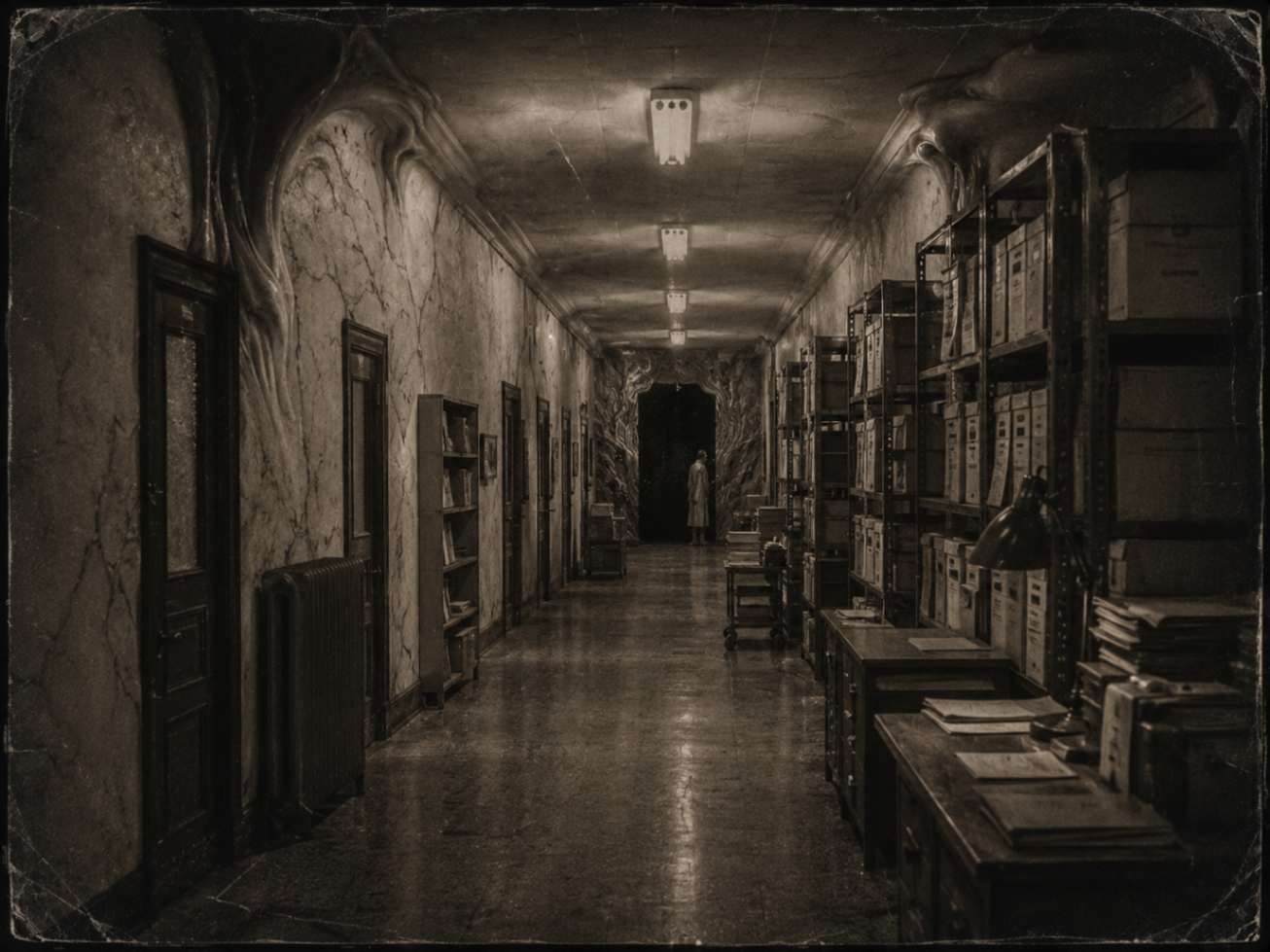
Everything set out above is drawn from the Common Record, the Institute’s single continuous archive, held at the North House and reconciled annually against the house books. Members and visitors may read it. Where two accounts of a matter survive, both are kept and the matter is marked referred.